- YOUR LOADOUT SETS THE PACE
- TACTICS OVER TWITCH
- DEATH IS NEVER PERMANENT
- NPCS LIVE BY THE SAME RULES
- 10,000-CAPTAIN BATTLES AT FULL SPEED
You're a swashbuckling adventurer with a crew that depends on you. Take a contract off the station board, run a blockade through contested space, and limp home with a hold full of salvage while your chief grumbles about what you did to her engines. Your crew are people, each with short-term goals and life goals of their own, and helping them get there unlocks real rewards. Their unique abilities are yours to call on, and morale is the throttle: keep it high and they work at full speed; let it slide, and everything they do for you slows down.
You control the pacing through your loadout, with a feel Gloomhaven players will recognize: standard play stays smooth, but in a crisis every decision carries a payoff and a risk. So take the risk. Player and crew death are never permanent, and the captains worth following are the ones who learned the hard way. Even completing a life's journey isn't the end: finish your captain's story and either ascend into something far greater, or begin a new legend with a new name and a new past.
And the galaxy remembers, because it's alive: thousands of persistent NPCs live by the same rules you do, flying the same ships, taking the same contracts, chasing goals of their own. Their behavior runs on cards too, Gloomhaven-style doctrine decks that nest into surprisingly rich rulebooks, so a pirate picket and a merchant convoy are genuinely playing the game, not running a script. And when you log off, the choice is yours: slip quietly out of the world after a while, or hand the helm to one of your own doctrine cards and let your ship keep flying your orders while you sleep. When you break a blockade or burn a station's trust, that isn't a scripted event resetting for the next player. It's the plot, changed. And someone is watching it change: monitors track the big events and patterns across the galaxy, and human game masters, with AI drafting the briefings, decide how the world answers. A trade war you started can draw a Charter response. A region you bled dry can turn desperate. The story bends around what players actually do, curated by people whose whole job is keeping it fun.
Then there's the idea the whole design is built around. Every mechanic in Black Skies was shaped from day one so that fleets can converge at full speed. No time dilation by design. No molasses, no fight slowed to a crawl because the server is busy. The biggest battle in the galaxy should play exactly like your first one, and if your shot misses in the chaos, it's because the target dodged or a wreck drifted into the lane, never because a server hiccuped. Curious how that's even possible? The full technical story is an eight-part engineering series at jeffrey.blog.
Start solo. Fall in with a crew of captains. End up in the battles they name eras after.
THE DRYDOCK · A GUIDED TOUR IN SIX CHAPTERS · SCROLL AT YOUR OWN PACE
Everything is a card. Every card has an owner.
The hull opens into typed sockets. Modules are cards that live in them, and a socket's shape is its slot type: an attack card like Basic Gun cannot sit in a thruster slot. A damaged module is a dead card until someone repairs it.
SOCKET SHAPE = SLOT TYPE · DAMAGED MODULES DO NOT WORK
Berths hold people the way sockets hold modules.
The hull sets the crew count, and every crew member brings ability cards of their own, like Tashi's Patch Thrusters. Morale is the throttle: Mara is at 55 and working slow. K-7 is unconscious, not working, never dead. And one berth is open.
UNCONSCIOUS CREW DO NOT WORK, AND NEVER DIE · LOW MORALE WORKS SLOWER
A hand of real cards. Capacitors pay for every play.
You hold up to five cards from your ship, your captain, and your crew. Playing one drains a capacitor for that ability's duration: Basic Thruster costs about two seconds, Advanced Laser's PrecisionShot locks a cell for most of a minute, and the Emergency Beacon drains the cell it is tied to. Durations shown are illustrative.
PLAYING A CARD DRAINS A CAPACITOR · THE ABILITY SETS THE DURATION
Two ships. Two decks. One rulebook.
The pirate is not running a script. It plays cards from its own doctrine deck, under its own crest, by the same rules you follow. Flip your helm to doctrine and your Automation deck takes the ship, playing your cards while you sleep.
SAME RULES, SEPARATE DECKS · THE GALAXY DOES NOT RUN ON SCRIPTS
The world's story arrives as cards.
The world and each region carry mission cards, short-term and long-term. They feed down into the three mission slots your ship carries. Take the relief run, break the blockade, or hold a slot open for whatever you find out there. Mission names here are illustrative.
MISSIONS FLOW WORLD TO REGION TO SHIP · MAX 3 ABOARD · ONE SLOT OPEN
Personal stories nested inside a world story.
Everyone aboard carries one life goal and three short-term goals, and so do the ship, the region, and the world. Watch Tashi source her injector: the goal completes and the reward lands on her card. Her life goal is an engine shop of her own. The captain's is Charted Horizons. Crew goal names shown here are illustrative.
MEET A GOAL AT ANY LAYER, REWARDS FLOW

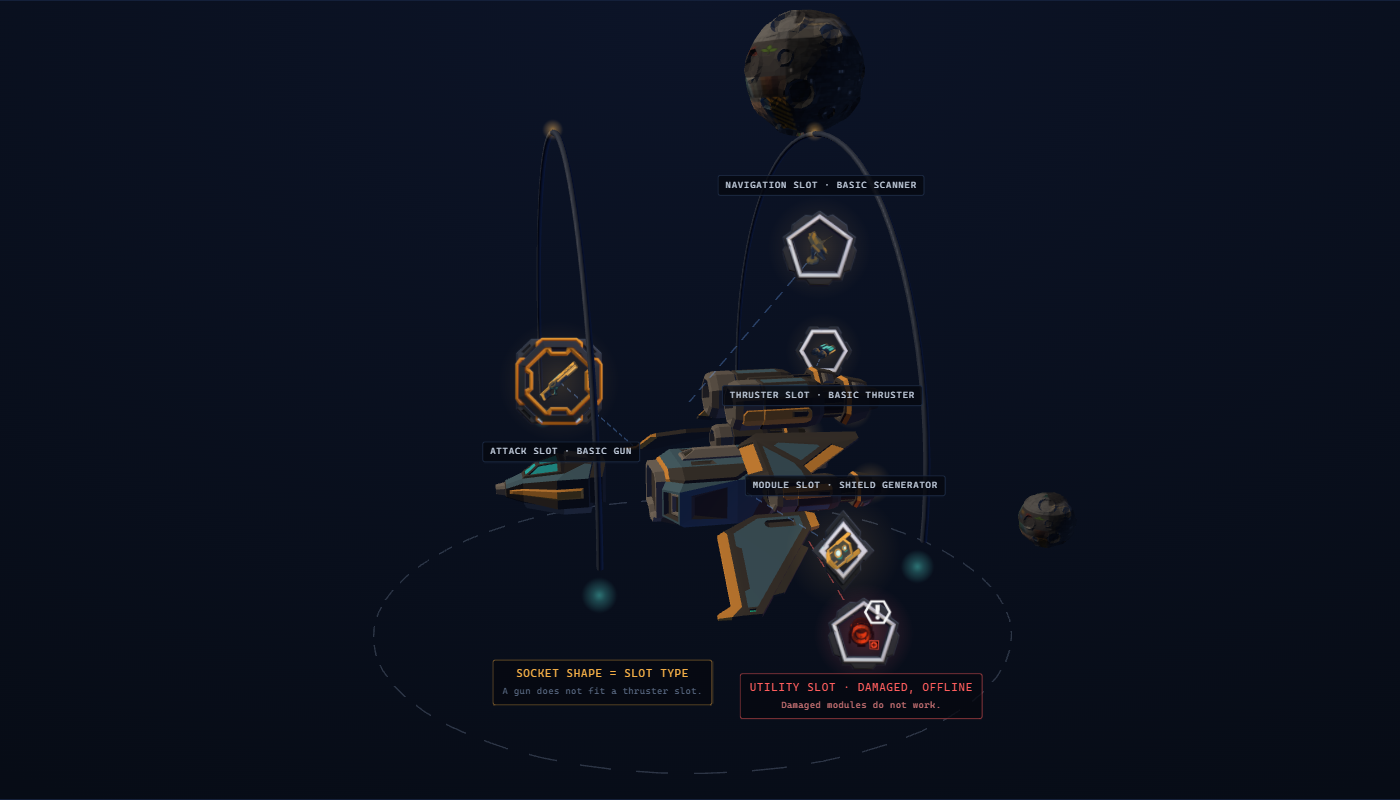
The hull opens into typed sockets. Modules are cards that live in them, and a socket's shape is its slot type: an attack card like Basic Gun cannot sit in a thruster slot. A damaged module is a dead card until someone repairs it.
SOCKET SHAPE = SLOT TYPE · DAMAGED MODULES DO NOT WORK
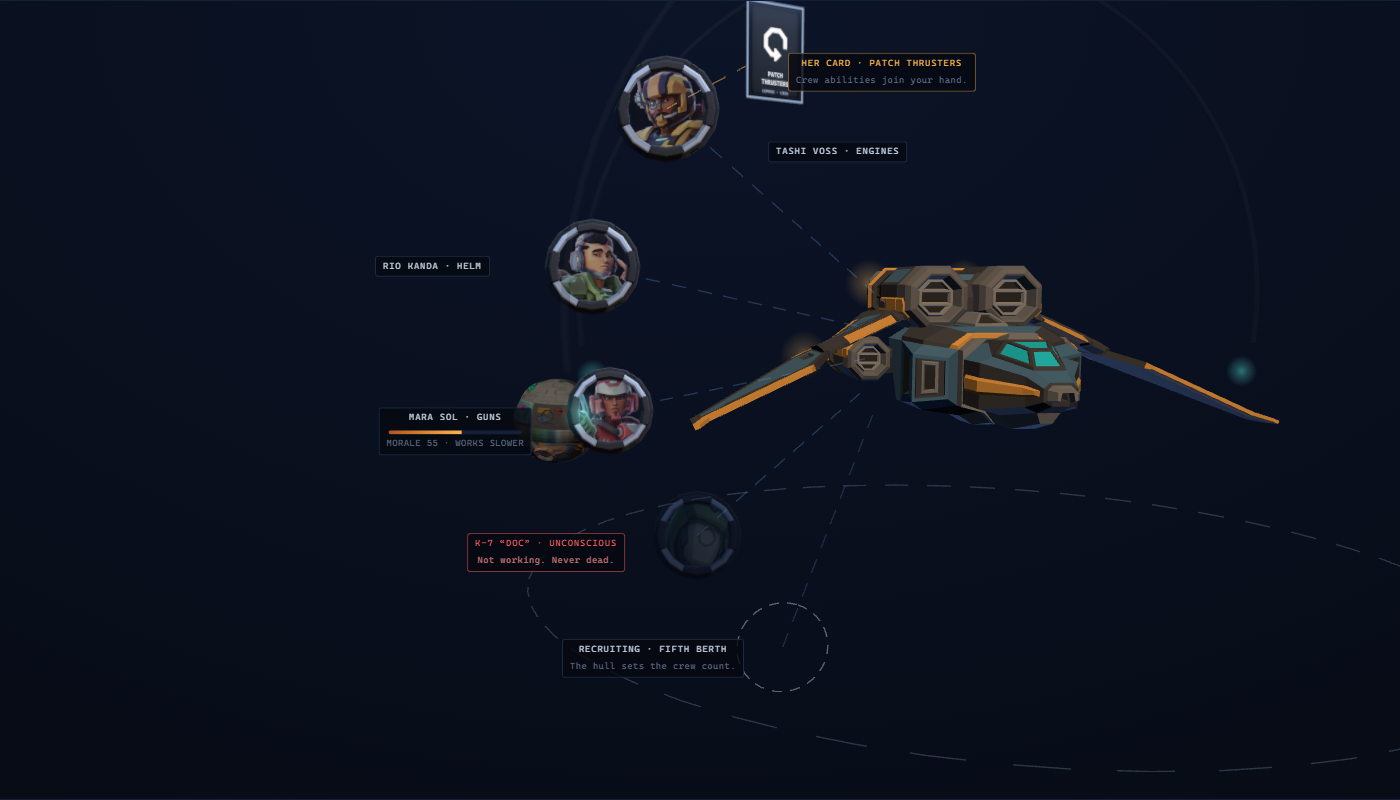
The hull sets the crew count, and every crew member brings ability cards of their own, like Tashi's Patch Thrusters. Morale is the throttle: Mara is at 55 and working slow. K-7 is unconscious, not working, never dead. And one berth is open.
UNCONSCIOUS CREW DO NOT WORK, AND NEVER DIE · LOW MORALE WORKS SLOWER
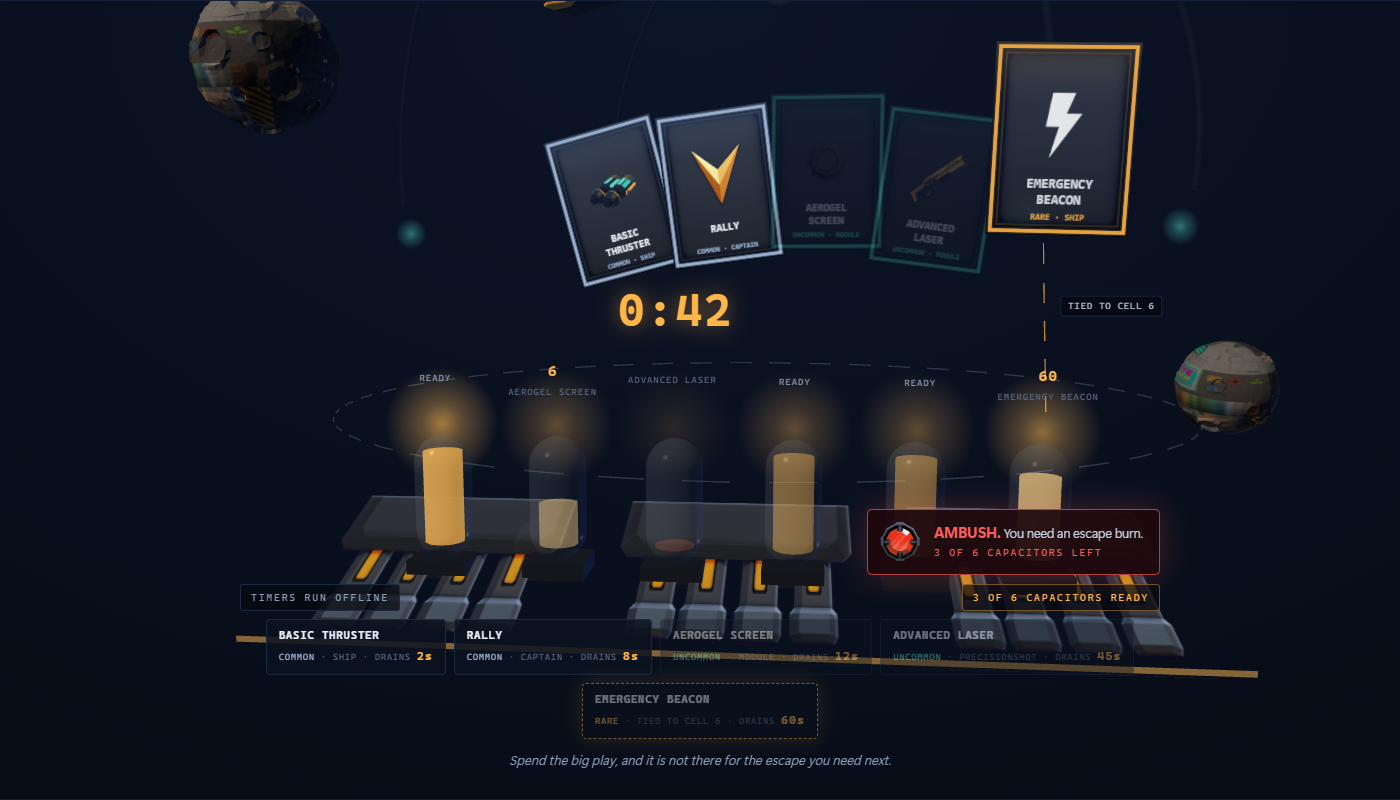
You hold up to five cards from your ship, your captain, and your crew. Playing one drains a capacitor for that ability's duration: Basic Thruster costs about two seconds, Advanced Laser's PrecisionShot locks a cell for most of a minute, and the Emergency Beacon drains the cell it is tied to. Durations shown are illustrative.
PLAYING A CARD DRAINS A CAPACITOR · THE ABILITY SETS THE DURATION
TIMERS RUN OFFLINE
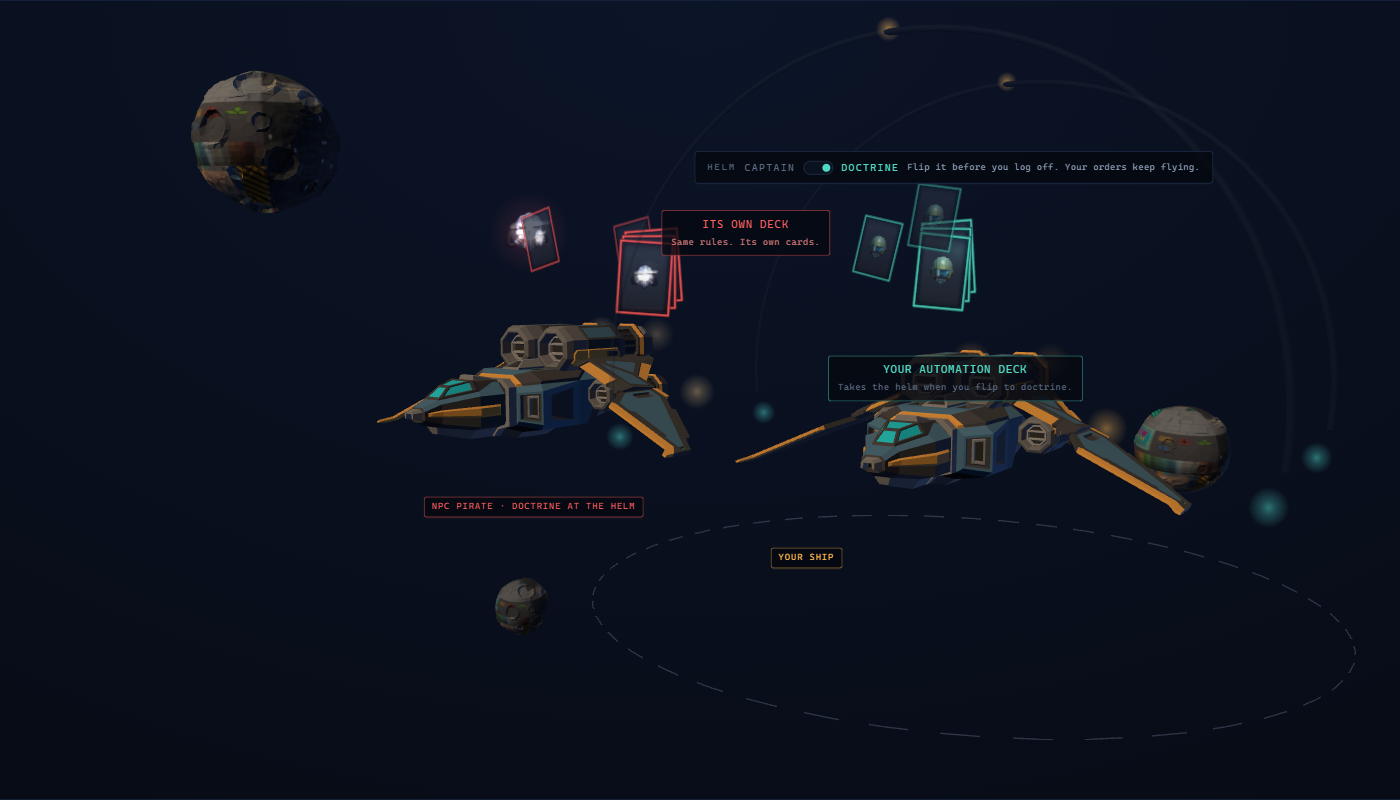
The pirate is not running a script. It plays cards from its own doctrine deck, under its own crest, by the same rules you follow. Flip your helm to doctrine and your Automation deck takes the ship, playing your cards while you sleep.
SAME RULES, SEPARATE DECKS · THE GALAXY DOES NOT RUN ON SCRIPTS
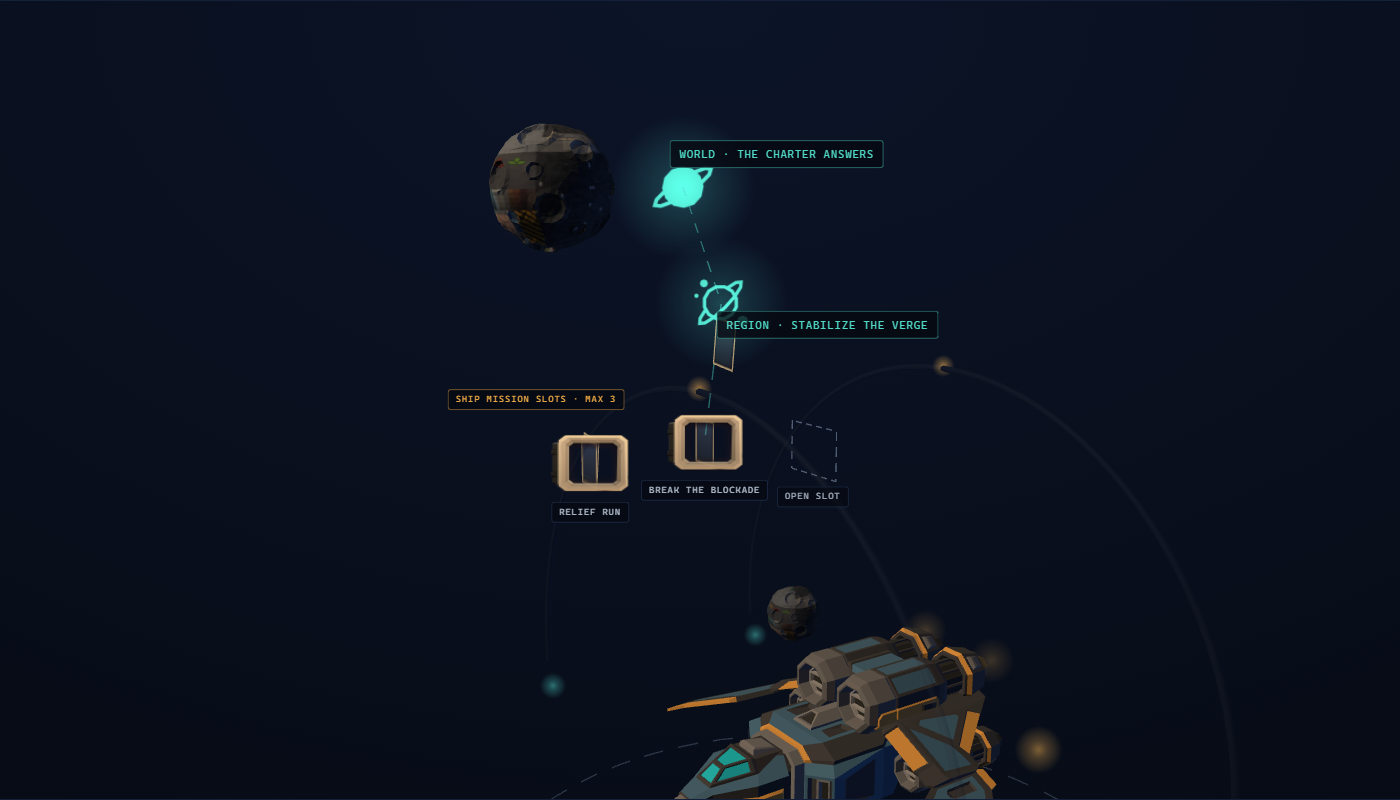
The world and each region carry mission cards, short-term and long-term. They feed down into the three mission slots your ship carries. Take the relief run, break the blockade, or hold a slot open for whatever you find out there. Mission names here are illustrative.
MISSIONS FLOW WORLD TO REGION TO SHIP · MAX 3 ABOARD · ONE SLOT OPEN
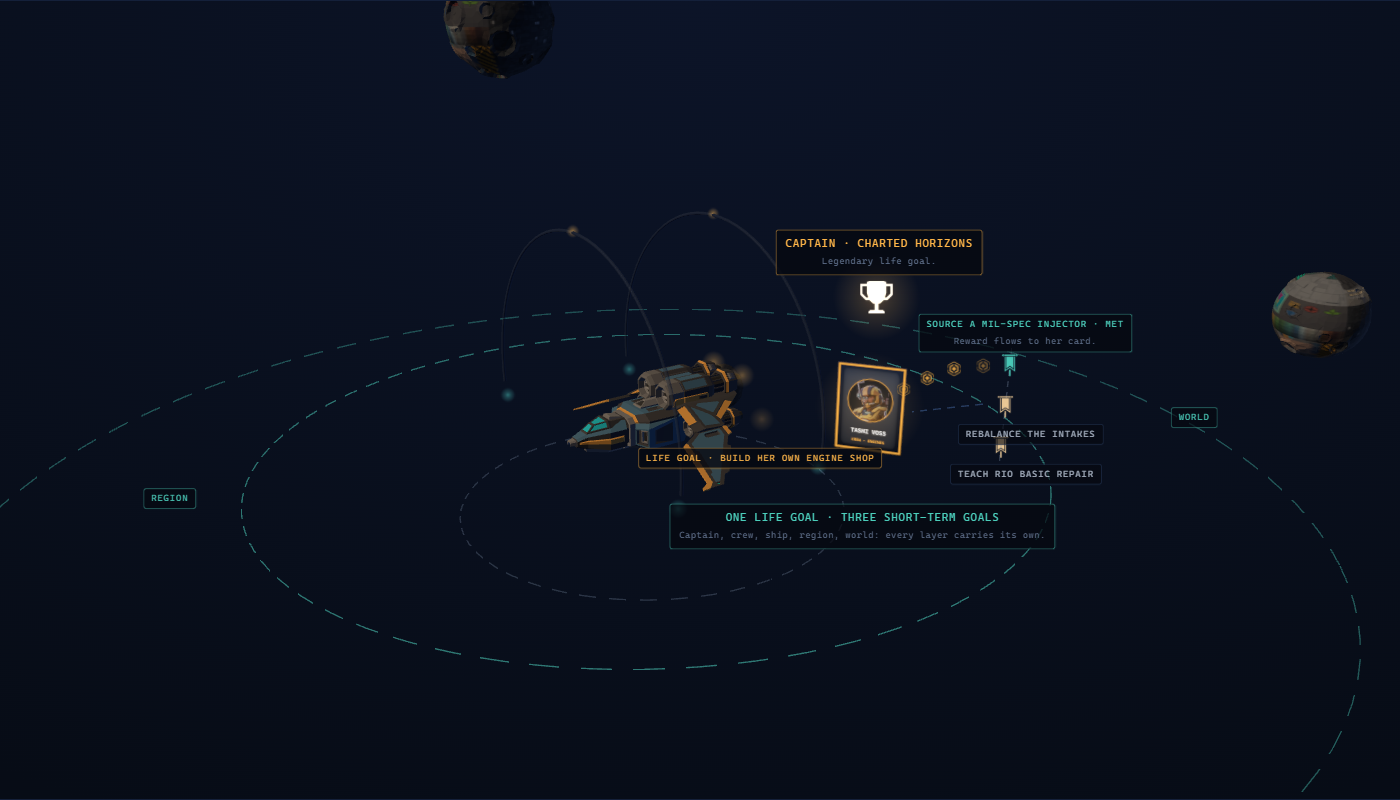
Everyone aboard carries one life goal and three short-term goals, and so do the ship, the region, and the world. Watch Tashi source her injector: the goal completes and the reward lands on her card. Her life goal is an engine shop of her own. The captain's is Charted Horizons. Crew goal names shown here are illustrative.
MEET A GOAL AT ANY LAYER, REWARDS FLOW
Black Skies is in the shipyard. The full-speed promise gets proven in public trials before launch. Card names and rarities above are the real ones from the game's data; drain durations, mission names, and crew goal names are illustrative until balancing settles.
From the designer who shipped Alteil, a live tactical card game with tens of thousands of players, playing card games since Revised-era Magic.